
Stake Keno Guide: How to Play, Real Odds & Risk Levels Explained
Keno just got a full refresh on Stake. Here is how the 40-number board works, the true odds of hitting every pick, what Classic, Low, Medium and High risk actually change, and a calm way to play it.
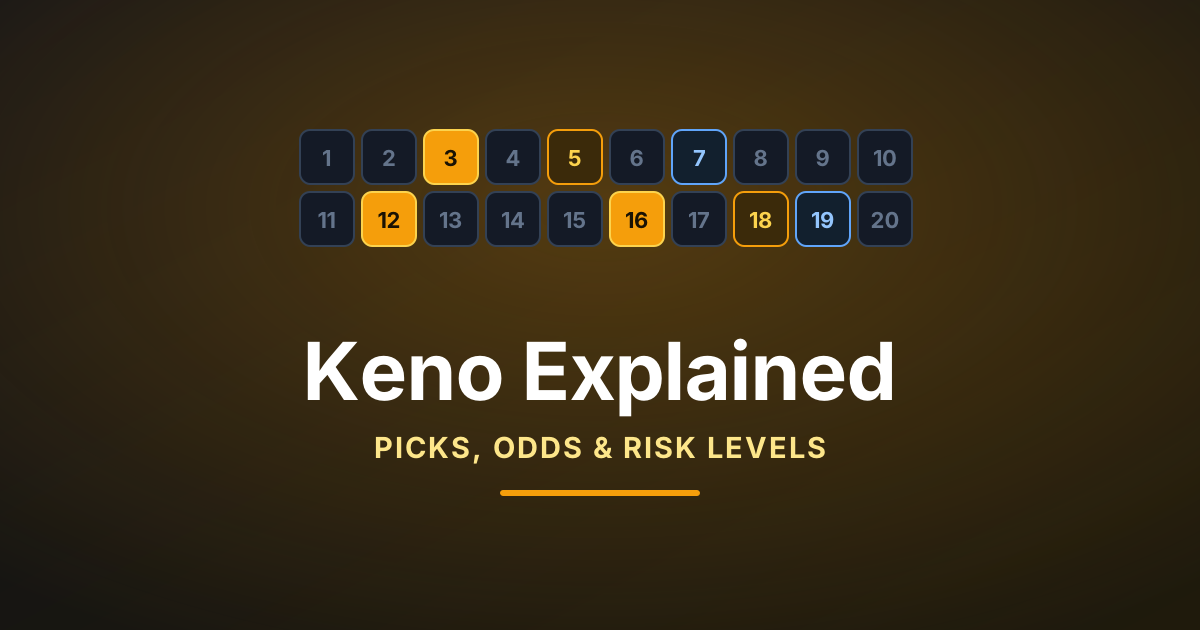
Keno is one of the oldest games in the Stake Originals lobby, and in late October 2026 it got a proper glow-up: cleaner tiles, smoother animations, a more compact pay table (with tooltips that finally work on mobile), drag-to-select, and a Numbers to Pick dropdown so Random Pick can fill anywhere from 1 to 10 spots for you. Auto and instant play are faster too. The important part: payouts and odds did not change. Same game, nicer to play. Here's everything you need to know.
How Stake Keno works
- The board has 40 numbers.
- You pick between 1 and 10 of them (each pick is called a "spot").
- The game draws 10 numbers at random.
- You're paid based on how many of your spots were drawn, using the pay table for your spot count and risk level.
Because 10 of the 40 numbers get drawn, any single spot has exactly a 25% chance of being hit. Everything else is just that idea stacked up.
The real odds of hitting every pick
The more spots you choose, the more ways you can partially match — but hitting all of them gets dramatically harder. These are the exact odds of matching every number you picked on a 40-number, 10-draw board (we did the math ourselves: C(10,k) ÷ C(40,k)):
| Spots picked | Chance all of them hit |
|---|---|
| 1 | 1 in 4 |
| 2 | 1 in 17 |
| 3 | 1 in 82 |
| 4 | 1 in 435 |
| 5 | 1 in 2,611 |
| 6 | 1 in 18,278 |
| 7 | 1 in 155,363 |
| 8 | 1 in 1,708,993 |
| 9 | 1 in 27,343,888 |
| 10 | 1 in 847,660,528 |
That last line is not a typo. A perfect 10-for-10 is roughly as likely as picking one specific ticket out of 847 million. That's why the top payouts on high spot counts look so huge — and why they almost never land. Partial matches are where the action really happens.
How many spots should you pick?
There's no "best" number — only different experiences:
- 1–3 spots: easy to follow, frequent outcomes, smaller multipliers.
- 4–6 spots: the middle ground with a spread of partial-match payouts.
- 7–10 spots: lottery-style. Big ceilings, lots of rounds that pay little or nothing.
Decide your spot count before you start and keep it consistent. Adding spots because the last round "almost hit" changes nothing about the next draw.
Risk levels: Classic, Low, Medium, High
This is the part most players misread. The risk setting does not change your odds of matching numbers — the draw is identical. It only reshapes the pay table:
- Low / Classic: more of the pay table goes to partial matches, so smaller wins come more often.
- Medium: a balance between hit frequency and top-end multipliers.
- High: partial matches pay little or nothing, and the value is pushed into rare, big results.
Before you play, open the pay table for your spot count and flick between the risk levels. Look at what 3, 4 and 5 matches pay — not just the headline multiplier. That tells you far more than the label does.
Tips for a calmer Keno session
- Read the pay table first. Know which match counts actually pay at your settings.
- Keep a flat stake. Raising your bet after a loss doesn't improve the next draw — it just speeds up your session.
- Random Pick is a convenience, not an edge. Your birthday numbers and the game's random ones have identical odds.
- "Hot" and "overdue" numbers don't exist. Every draw is independent.
- Set limits before Auto play. The new faster auto mode burns through a budget quickly if you let it. See our bankroll management guide.
Stake Keno vs classic Keno, bingo and lotto
Land-based Keno usually uses an 80-number board with 20 drawn. Stake's version is a "mini" format — 40 numbers, 10 drawn — which makes rounds snappier and the odds easier to reason about. Unlike bingo, you choose your own numbers; unlike a lottery, a round takes a second and you can play the next one immediately (which is exactly why limits matter).
Is it fair?
Keno is a provably fair Stake Original. Each round's result is derived from a server seed, your client seed and a nonce, and you can check any past round in the game's Fairness tab. New to the concept? Read Provably Fair Explained, and for the rest of the in-house lineup see Stake Originals Explained.
Make every round count twice
Keno wagers count like any other casino play. Under code TGZZ they push you toward wager milestones and up the monthly leaderboard, on top of whatever the board pays.
Keno is a game of chance with a built-in house edge. No strategy changes the odds. Play for entertainment, within your means. 18+ only.